
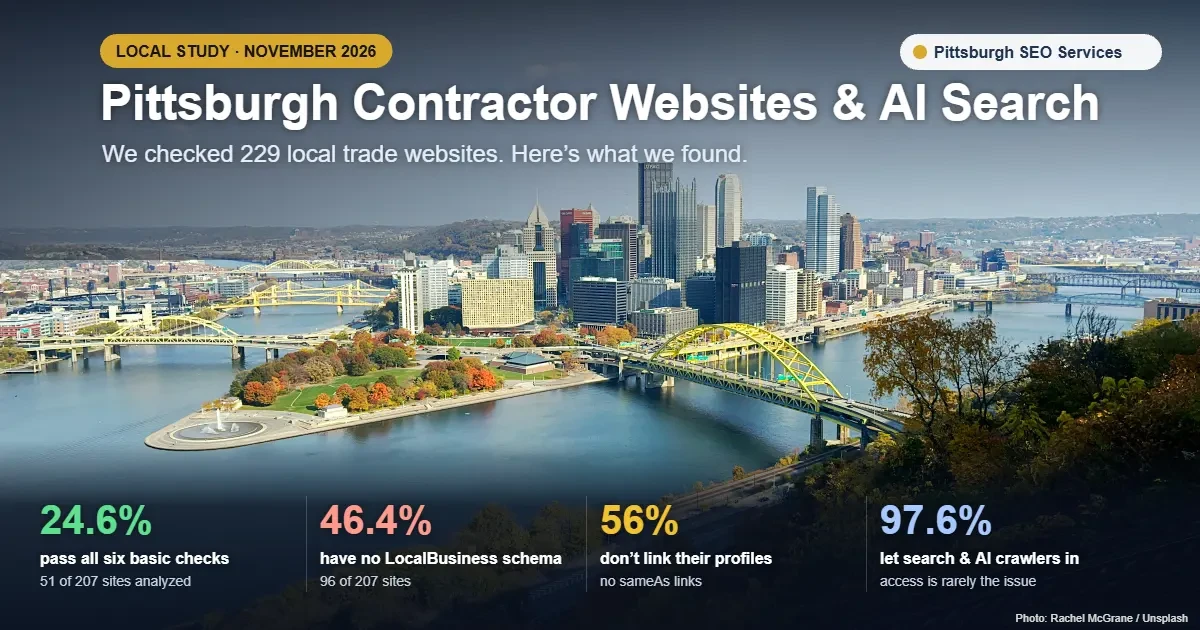
We ran 229 Pittsburgh-area contractor and home service websites through our free AI Search Visibility Checker. Almost all of them let Google and AI search tools in. The problem is what those tools find once they get there.
Header photo: Rachel McGrane on Unsplash.
Key Findings
- Access is rarely the problem. 97.6% of the sites we could read let Google, Bing, ChatGPT search, Claude search and Perplexity crawl their homepage.
- Only about 1 in 4 (24.6%) pass six basic checks that help search engines and AI tools understand a local business.
- 46.4% have no LocalBusiness-type schema (the structured data that states a business’s name, address, phone and service), and 28.5% have no business schema of any kind.
- 56.0% don’t connect their website to their Google, Facebook or other profiles in their structured data.
- 3 sites block every crawler, including Google, almost certainly by accident.
- A third (33.8%) already have an llms.txt file, mostly because their website builder (Duda or Wix) creates one automatically.
Why We Did This Study
More homeowners now ask Google’s AI Overviews, ChatGPT or Perplexity to recommend a roofer or plumber instead of scrolling through ten blue links. Those tools can only recommend a business they can reach and understand. We wanted to know how ready Pittsburgh’s trade businesses are, using the same checks we run for our own clients.
How We Ran the Study
- Sample. We searched Google’s local results for 14 trades in Pittsburgh, PA: roofing, plumbing, HVAC, electrical, landscaping, remodeling, painting, concrete and masonry, tree service, pest control, garage doors, house cleaning, handyman and dumpster rental. We collected every website linked from those results.
- Cleanup. We removed booking and scheduling links, social media pages, national franchise headquarters sites and our own clients. That left 229 unique local business websites.
- Checks. On November 24, 2026 we ran each homepage through our AI Search Visibility Checker. It reads the site’s robots.txt, llms.txt and homepage HTML, the same public files any crawler sees.
- Analysis. 22 sites didn’t return a working homepage to our checker (timeouts, errors or blocked automated requests), so the findings below are based on the 207 sites we could read.
We don’t name any business in this report. The goal is to show patterns, not to single anyone out.
Finding 1: Almost Every Site Lets Search and AI Crawlers In
Robots.txt is the file that tells crawlers what they may visit. Blocking the wrong crawler can take a business out of Google or out of AI answers entirely. The good news is that very few local contractors have this problem.
Most of the sites that block AI training crawlers use an identical set of rules that leaves search crawlers alone. That pattern most likely comes from a hosting or CDN setting rather than a choice the business owner made. It’s a reasonable setup: blocking training crawlers such as GPTBot and ClaudeBot doesn’t remove a site from ChatGPT or Claude search, which use separate crawlers.
The 3 sites that block everything are a different story. A rule like User-agent: * followed by Disallow: / tells every crawler, Google included, to stay away. It’s often left over from when a site was built. If you’ve never checked your robots.txt, our free Robots.txt Checker takes a few seconds.
Finding 2: Nearly Half Don’t Tell Search Engines What Kind of Business They Are
Structured data (schema markup) is code that states facts in a format machines read reliably: business type, address, phone, hours, service area and links to official profiles. Google recommends LocalBusiness structured data for local businesses, and AI tools rely on the same consistent facts.
Most sites have some structured data, but much of it is generic page markup added automatically by a theme or SEO plugin. Only 53.6% say what kind of local business they are, and 56.0% don’t link their site to their Google Business Profile, Facebook page or other listings. Those links help search engines and AI tools confirm that the website, the map listing and the reviews all belong to the same company.
We also found review-star markup on 13.0% of homepages. Google doesn’t show star ratings for reviews a business publishes about itself in LocalBusiness or Organization markup, so this markup doesn’t produce stars in search results.
You can create LocalBusiness schema in a couple of minutes with our free Local Business Schema Generator.
Finding 3: Basic On-Page Gaps Are Common
None of these will sink a site on its own, but they add up. A homepage with no clear heading, no summary and little text gives Google and AI tools very little to quote when someone asks who to call.
Finding 4: Only 1 in 4 Sites Pass All Six Basics
We scored every homepage on six checks that matter for local and AI search visibility:
- Google, Bing and the main AI search crawlers are allowed
- LocalBusiness-type schema is present
- The schema links to at least one other profile (sameAs)
- The page has a meta description
- The page has exactly one H1 heading
- The page has at least 300 words of readable text
Three quarters of the local contractors we checked are leaving easy wins on the table. None of these fixes is expensive, and most take less than an hour for whoever manages the site.
Finding 5: Your Website Platform Makes a Big Difference
The biggest surprise was how much the website builder shapes the results. Duda and Wix add LocalBusiness schema and an llms.txt file automatically for many sites. On WordPress, the most common platform in our sample, both depend on the theme and plugins the site owner chose.
| Platform | Sites | LocalBusiness schema | llms.txt file |
|---|---|---|---|
| Duda | 20 | 16 (80%) | 20 (100%) |
| Wix | 16 | 12 (75%) | 16 (100%) |
| WordPress | 87 | 39 (45%) | 13 (15%) |
| Squarespace | 12 | 7 (58%) | 1 (8%) |
| GoDaddy | 9 | 4 (44%) | 3 (33%) |
That’s why a third of the sites already have an llms.txt file, a proposed standard that gives AI tools a short summary of a site. It’s optional and the major AI search tools haven’t said they rely on it, so we don’t count it in the six basics. A WordPress site can match or beat a site builder, but someone has to set it up.
By Trade
Results varied by trade, but the samples are small (10 to 18 sites each), so treat these as directional.
| Trade | Sites | LocalBusiness schema | Links to other profiles |
|---|---|---|---|
| Tree service | 17 | 71% | 47% |
| Garage doors | 18 | 67% | 61% |
| Roofing | 18 | 61% | 61% |
| Electrical | 15 | 60% | 27% |
| Concrete & masonry | 14 | 57% | 36% |
| HVAC | 16 | 56% | 56% |
| Painting | 13 | 54% | 62% |
| Plumbing | 16 | 50% | 50% |
| Pest control | 10 | 50% | 30% |
| Landscaping | 15 | 47% | 40% |
| House cleaning | 11 | 45% | 45% |
| Handyman | 16 | 44% | 31% |
| Remodeling | 17 | 41% | 12% |
| Dumpster rental | 11 | 36% | 55% |
What Pittsburgh Contractors Should Do Next
- Check your robots.txt and make sure Googlebot, Bingbot and AI search crawlers aren’t blocked.
- Add LocalBusiness schema with your business type, address or service area, phone, hours and services, matching your Google Business Profile exactly.
- Link your profiles with sameAs: Google Business Profile, Facebook, LinkedIn, BBB and your main directory listings.
- Fix the homepage basics: one clear H1, a meta description that says what you do and where, and enough plain text to answer what customers ask.
- Keep earning reviews on your Google Business Profile. AI assistants often summarize what customers say about a business.
Want to see where your own site stands? Run it through the free AI Search Visibility Checker. It takes about ten seconds and shows the same checks we used in this study.
Limitations
- We checked homepages only. Service pages and contact pages may have schema or content the homepage doesn’t.
- Our checker reads the HTML a server sends before JavaScript runs. Structured data added only by JavaScript may be missed.
- Firewalls and CDNs can block AI crawlers without any robots.txt rule. Our checker can’t see those blocks, so real-world blocking may be higher.
- Sites that didn’t respond to our checker (22 of 229) were left out. Some of them may block automated requests in general.
- The sample comes from Google’s local results for 14 searches on one day, so it reflects businesses that already show up in local search, not every contractor in the region.
- This is a snapshot from November 24, 2026. Websites, crawlers and platforms change often.
Frequently Asked Questions
How many Pittsburgh contractor websites block AI search crawlers?
Very few. Of the 207 contractor homepages we could read, 4 (1.9%) blocked at least one AI search crawler (OAI-SearchBot, Claude-SearchBot or PerplexityBot), and 3 blocked all crawlers including Google.
What is the most common problem on Pittsburgh contractor websites?
Missing or incomplete structured data. 46.4% of homepages had no LocalBusiness-type schema, and 56.0% didn’t link to the business’s other profiles.
Do contractors need an llms.txt file?
No. llms.txt is an optional, proposed standard. 33.8% of the sites we checked have one, mostly because Duda and Wix create it automatically. Fixing schema and on-page basics matters more.
Can I use this data?
Yes. You’re welcome to quote or chart these findings with a link to this page as the source.
How can I check my own website?
Use our free AI Search Visibility Checker, or contact us for a free website and local SEO review. You can also call 412-250-7965.

Jonathan Crain is the owner of Pittsburgh SEO Services LLC, a Pittsburgh, PA agency specializing in affordable WordPress websites and digital marketing campaigns.
He holds a marketing degree with a focus on digital marketing and multiple internet marketing certifications, and has 25+ years of experience managing hundreds of website projects and marketing campaigns. He has written hundreds of website design and marketing articles and has won awards from the Tribune-Review, Post-Gazette and other publications.